
God Walking With Us
Imagine what it would be like going to Israel and discovering God walking in the Kotel. You might have a sense of wonder, and strangely, confidence as you see him teaching students and healing people who were once paralyzed. You see people praising God in response to being healed. You start walking toward the crowd surrounding him and notice joy, shock, and wonder in peoples’ eyes.
During the first century, many thousands of Jewish people in Jerusalem believed that Yeshua (Jesus) of Nazareth was God. In 2017, a Barna study found that 21% of Jewish millennials believe that Jesus was “God in human form who lived among people in the 1st century.”1 Let’s dig further and ask: Why did those who encounter Yeshua during his life believe that he was God walking among them?
Walking on Water
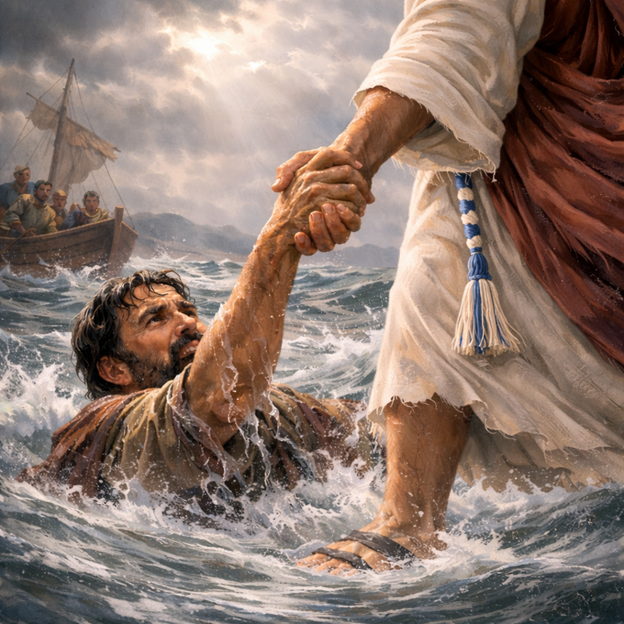
What Christians call “the Gospels” are four ancient biographies of Yeshua, a rabbi from Judea written by Jewish people in the first century CE. One of Yeshua’s disciples, Matthew, records that one evening when the disciples were sailing on the Sea of Galilee, they saw Yeshua “walking on the sea” (Matt 14:25). They were terrified, thinking that he might be a ghost. Peter, called out, “Lord, if it is you, command me to come to you on the water” (Matt 14:28). Yeshua answered him, commanding him to come. Peter, then stepped out of the boat and “walked on the water” (Matt 14:29). However, when Peter saw the wind, he was filled with fear, and when he began to sink, he called out, “Lord, save me” (Matt 14:30). Yeshua answered Peter’s cry and reached out his hand to rescue him. Yeshua brought Peter back into the boat and Yeshua’s disciples worshipped him. They recognized Yeshua as the Lord––the one who walks on the water (Job 9:8). When God redeemed us out of Egypt, we sang as we walked through the parted Red Sea, “The LORD is my strength and my song, and he has become my salvation [ישׁוּעָה]” (Exod 15:2). Yeshua whose very name means “salvation,” saved Peter, lifting him up from the water to walk with him.
Making a Paralyzed Man Walk
Luke, a Jewish historian who interviewed eyewitnesses, records a time when Jewish people had come from across Galilee, Judea, and Jerusalem to experience Yeshua teach and heal. A group lowered a paralyzed man through the roof so that Yeshua could heal him. Yeshua responds, “Man, your sins are forgiven” (Luke 5:20). He did something that only God has the authority to do, forgive sin, as the Torah teaches, “[The Lord is] abounding in steadfast love and faithfulness, keeping steadfast love for the thousandth generation, forgiving iniquity and transgression and sin” (Exod 34:6–7). Anyone can claim to forgive sin, but Yeshua followed this up by healing the man. Yeshua said, “‘I say to you, rise, pick up your bed and walk home.’ And immediately he rose up before them and picked up what he had been lying on and went home, glorifying God” (Luke 5:24–25). Yeshua forgave the man’s sins and demonstrated his authority to do so by making this man who is paralyzed walk with a simple command.
Making a Dead Girl Live
Mark, who recorded the disciple Peter’s testimony, writes about a time when Yeshua was asked to heal a synagogue leader’s daughter who was dying. While Yeshua was on his way to heal her, she died. Instead of turning around, Yeshua went to the girl while people were in the process of mourning. Mark writes, “Taking her by the hand [Yeshua] said to her, ‘Talitha cumi,’ which means [in Aramaic], ‘Little girl, I say to you, arise.’ And immediately the girl got up and began walking (for she was twelve years of age), and they were immediately overcome with amazement” (Mark 5:41–42). Yeshua raised the girl by his own command and authority, something only God has the power to do (Deut 32:39). The Amidah echoes the consistent teaching of the Tanakh:
Lord, You are mighty forever. You call the dead to life. You are mighty to save. You sustain the living with loving kindness, and with great mercy You revive the dead…You decree death and restore life, causing salvation to come forth. You are faithful to revive the dead. Blessed are You. Lord, who calls the dead to life.
Making Blind Men See
Matthew records a moment two blind men heard Yeshua walking by and they called out to him,
“Lord, have mercy on us, Son of David!” And stopping, Yeshua called them and said, “What do you want me to do for you?” They said to him, “Lord, let our eyes be opened.” And Yeshua in pity touched their eyes, and immediately they recovered their sight and followed him (Matt 20:31–34).
These blind men believed Yeshua to be the Lord, and they boldly asked him to open their eyes. Yeshua did this by his own authority. As the Psalmist writes, “the LORD opens the eyes of the blind” (Ps 146:8).
God Walking Among Us
The earliest Jewish followers of Yeshua believed that he was God walking among us. They saw Yeshua walk on water, heal those who were paralyzed, raise dead people to life, and open the eyes of the blind. They saw Yeshua bring about these signs of Israel’s restoration (Isa 26:19; 29:18; 35:5–6; 42:18), enabling Jewish people to walk with him unhindered from disability, blindness, or even death.
Yeshua was seen as God walking with us and enabling us to walk, which is predicted in the Tanakh: “And I will walk among you and will be your God, and you shall be my people. I am the Lord your God, who brought you out of the land of Egypt, that you should not be their slaves. And I have broken the bars of your yoke and made you walk upright.” (Lev 26:12–13).
Yeshua’s disciple, John, records Yeshua “walking in the temple” on Hannukah (John 10:22–23). Yeshua spoke as the Lord, Israel’s shepherd, saying, “My sheep hear my voice, and I know them, and they follow me. I give them eternal life…” (John 10:27–28).


 Credit: Freepik
 Public Domain