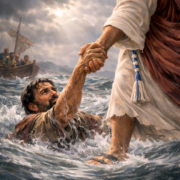
Walking With God

Walking is the most basic way humans have traveled throughout history. It is a way to exercise, relieve stress, connect with others, or simply get from place to place in urban environments like New York City. “Walking” is also the language the Tanakh uses to describe how God calls Israel to live. While halakha can be used in a narrow way to strictly refer to Jewish legal rulings and traditions, for centuries it has also been used to sum up our experience of living Jewish lives; it literally means “the walk.” As we move through different passages in the Tanakh, we will see how walking carries deep spiritual significance.
God Walking us out of Egypt
Over three thousand years ago, when God freed our people from slavery in Egypt, the Torah tells us that God “walked [הֹלֵךְ] before [the Israelites] in a pillar of cloud by day, to guide them along the way, and in a pillar of fire by night, to give them light” (Exod 13:21). God walked before us, protecting us from the Egyptians, and we “walked [הָלְכוּ] on dry ground through the sea” (Exod 14:29). Throughout Israel’s journey in the wilderness, God continued to walk with us and dwell among us in the pillar of cloud by day and fire by night, guiding, protecting, and remaining present. As the Torah states, “God walks [מִתְהַלֵּךְ] in the midst of your camp, to deliver you and to give up your enemies before you…” (Deut 23:14). Moses later told His successor Joshua, in front of all the people, “The LORD Himself will walk [הַהֹלֵךְ] before you. He will be with you; He will not fail you or forsake you” (Deut 31:8).
God chose to deliver us from the bonds of slavery because He loves us. He chose to walk with us because He loves us as a father loves his children. When God made His covenant with Israel, He called Moses and the leaders of Israel up the mountain, and “they saw the God of Israel: under His feet there was the likeness of a pavement of sapphire, like the very sky for purity” (Exod 24:10). In revealing Himself this way, God showed that He is not distant or detached. He is a God who is relational. He is the God who walks with His people because He loves us.
“Walking” as Jewish life
God’s relationship with us is rooted in love, and He modeled His desire for our lives by walking with us. The Torah teaches, “And now, Israel, what does the LORD your God require of you, but to fear the LORD your God, to walk in all His ways, to love Him, to serve the LORD your God with all your heart and with all your soul…” (Deut 10:12). To love God with one’s whole being is to walk in His ways. This call is repeated throughout the Tanakh:
- “walk in my statutes” (Lev 26:3)
- “walk after the LORD your God” (Deut 13:4)
- “walk in His ways” (Deut 26:17)
- “walk in all His ways” (Josh 22:5)
- “walk before Me in faithfulness” (1 Kgs 2:4)
- “walk in My rules” (Ezek 37:24)
- “walk in the name of the LORD” (Mic 4:5)
- “walk in My ways” (Zech 3:7)
When King David described a right relationship with God, he wrote, “Blessed are those whose way is blameless, who walk in the law of the LORD. Blessed are those who keep his testimonies, who seek him with their whole heart, who also do no wrong, but walk in his ways” (Ps 119:1–3).
Walking with God in Exile
David’s son Solomon built the Temple so that God would dwell among His people on earth. Yet Israel eventually walked contrary to God and committed grievous sins in the very place where God dwelled. Because the covenant was violated, God’s presence departed from the Temple, leaving it vulnerable to destruction. The Babylonians destroyed the house where God had dwelled and forced our people into exile. Yet even in exile, God did not abandon us.
Nebuchadnezzar, king of Babylon, commanded the Jewish people under threat of death to bow down and worship an idol. Daniel records that three men refused this command and were thrown into the furnace because they chose to walk in God’s ways. After throwing them into the fire, Nebuchadnezzar exclaimed, “I see four men walking about unbound and unharmed in the fire, and the fourth looks like a divine being” (Dan 3:25). This scene captures a profound truth: when we walk in God’s ways, God walks with us, even through fire. As we read in Isaiah,
“Fear not, for I have redeemed you;
I have called you by name, you are mine.
When you pass through the waters, I will be with you…
when you walk through fire you shall not be burned,
and the flame shall not consume you.
For I am the LORD your God,
the Holy One of Israel, your Savior” (Isa 43:1–3).
God demonstrated His love for us by walking with us through the sea out of Egypt, walking with us through the wilderness, and walking with us even in exile. Through it all, He calls us to walk with Him, obeying Him by living the way He calls Jewish people to live—lives faithfully devoted to Him. The prophet Micah captures this well: “He has told you, O man, what is good; and what does the LORD require of you but to do justice, and to love kindness, and to walk humbly with your God” (Mic 6:8).
Walking with God through Life
Walking humbly implies walking in step with Him, not ahead of Him, not seeking our own way, and not turning away from Him, but walking with Him on the path God leads us to walk. Rabbi Daniel Nevins writes, “Is it any wonder that Judaism came to associate its method of religious practice with walking? The Rabbis created a normative world known as halakhah (‘the walk’)…”1 There is something unifying about walking with God through our shared practice, as we wait for God to walk with us physically again.