The Shroud of Turin: Jesus’s Resurrection Cloth
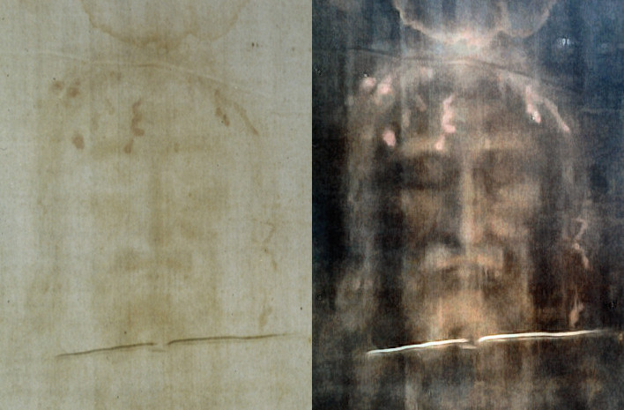 Wikimedia Commons
 The Shroud of Turin is the burial cloth believed to have once wrapped the crucified Yeshua (Jesus) of Nazareth. Though its documented history began in Lirey, France, in the mid-fourteenth century, earlier historical references suggest it was preserved, maintained, and passed down through generations in the early church.
Today, the shroud is housed in Turin, Italy, and has been the subject of scholarly investigation since 1898, when a photographic negative of the shroud revealed a startling discovery: a remarkably detailed and anatomically accurate image of a crucified man.
Since then, scholars from more than 100 disciplines have spent more than 500,000 collective hours investigating the shroud. The overwhelming scientific consensus is that the shroud is an authentic image of a crucified man. “[The image] is that of a real human form of a scourged, crucified man. It is not the product of an artist. The bloodstains are composed of hemoglobin and also give a positive test for serum albumin,” concluded the group of scientists who were involved in the Shroud of Turin Research Project (STURP) in 1981.1
In this article, we will argue the image of the crucified man of the shroud is indeed Yeshua and that it provides powerful evidence of his resurrection.
How do we know the Shroud is Yeshua’s burial cloth?
The image on the shroud of a badly scourged and crucified man uniquely fits the New Testament description of how Yeshua suffered and died, as well as the Tanakh’s prophetic description of the Messiah’s death.
According to mathematician and physicist Bruno Barberis, who spent more time with the shroud than any other scientist, the probability that the individual buried in the shroud could be any random crucified man from antiquity other than Yeshua of Nazareth is 1 in 200 billion.2 Barberis identified seven unique features that connect the man of the Shroud with Yeshua:
- Burial in a pure linen shroud. Victims of crucifixion were usually thrown into mass graves or left for scavengers. The Gospel writers wrote that Joseph of Arimathea purchased and wrapped Yeshua “in a clean linen cloth” (Matt 27:59). It was pure linen, unmixed with wool or cotton, as prescribed by Jewish law (Lev 19:19).
- Head wounds consistent with wearing a crown of thorns. Victims of crucifixion (or any other execution method) were not given crowns of thorns to wear. The New Testament contains the only record of this occurring in history when it mentions that the Roman soldiers twisted a crown of thorns and put it on Yeshua’s head to mock him, saying, “Hail, King of the Jews!” (Matt 27:29).
- Two prominent shoulder abrasions consistent with Yeshua carrying the crossbeam, as was also reported of Yeshua in the New Testament (John 19:17)
- Nail wounds in wrists and feet, consistent with being nailed to the cross. Rome more commonly bound crucifixion victims to their crosses because it was effective and cheaper than using metal nails. However, sometimes they used nails to create more agony for the victim. The Gospel writers recorded that the soldiers nailed Jesus to the cross (Matt 27:35), in fulfillment of Psalm 22:16: “They have pierced my hands and my feet.”
- Side wound without leg fractures. Roman soldiers usually broke the legs of crucified victims to speed up their deaths. However, the Gospel writers record that when the soldiers realized Yeshua was already dead, instead of breaking his legs, they thrust a spear into his side (John 19:33). The man of the shroud has a side wound consistent with a spear thrust and no broken bones. The Jewish prophets foretold that the Messiah would be “pierced for our transgressions” (Isa 53:5) and have no broken bones (Ps 34:20).
- Lack of washing and anointing of the body. The image on the shroud contains streaks of blood, indicating the body was not washed and anointed before burial. This indicates a rushed burial, which is in keeping with the Gospel accounts. Luke records that Yeshua was buried in haste because the Sabbath was about to begin, and the women had begun preparing the spices to return and anoint his body on Sunday, after the Sabbath (Luke 23:53–55).
- Brief entombment. The body appears to have remained in the cloth for less than 72 hours—long enough for the image to form, but not long enough for decomposition to alter the image or leave decomposition stains. This aligns with the brief entombment of Yeshua before His resurrection.
In addition, (8) the man of the shroud has an inverted “V” shape under his chin, indicating a plucked beard, as prophesied by Isaiah (Isa 50:6). (9) The shroud contains 58 pollen species unique to the Jerusalem region during spring, the exact time and place Yeshua was crucified (during Passover). (10) Mineral analysis of its limestone dust matches samples from ancient tombs in Jerusalem. (11) The image shows 372 visible scourge marks consistent with a Roman flagrum (the lateral scourge marks are not visible). Both the New Testament writers and prophets in the Tanakh spoke of the Messiah’s flogging (Isa 50:6; Isa 53: 1-12; Matt 27:26).
The evidence overwhelmingly points to the man of the shroud being none other than Yeshua. As Barberis estimated, the cumulative probability of a single crucified man exhibiting just seven of the above features is 1 in 200 billion.
Is the Shroud a Medieval Forgery?
Scientists have not been able to come up with any naturalistic explanation of how the image could have formed on the shroud. Some skeptics say it was created by an artist, citing a 1988 radiocarbon dating test, which dated the shroud to the Middle Ages.3
However, peer-reviewed studies since then, such as the 2019 study published in the Oxford University journal Archaeometry, reveal that the dating study used faulty sampling, questionable methodology, and tested a contaminated section of the cloth that was likely part of a medieval repair and unrepresentative of the entire cloth.4
Another dating study was conducted by a group of Italian scientists at the National Research Council (CNR), using wide-angle X-ray scattering to examine the structural degradation of the shroud’s cellulose fibers over time, and they dated the shroud to the first century.5
In addition, as mentioned earlier, after years of scientific analyses and tests covering a range of scientific disciplines, STURP found no artificial pigments. Instead, they found unusually high bilirubin (a byproduct of hemoglobin breakdown) levels on the cloth, consistent with the experience of severe physical trauma before death, a physiological feature no medieval forger could have faked. As the late Jewish researcher on the STURP team, Barrie Schwortz, concluded, “There was already enough scientific evidence to convince me, a non-Christian (and a total skeptic back in 1978), that the most plausible explanation for the Shroud of Turin is that it is the cloth that wrapped the crucified body of Jesus of Nazareth.”6
What Formed the Image on the Shroud?
If the image on the shroud was not the product of any human artist and indeed bears the image of a badly crucified man, namely Yeshua of Nazareth, how was the image formed?
Italian physicist Paolo Di Lazzaro and his team at ENEA Labs spent five years trying to answer that question, using excimer lasers and ultraviolet light experiments on raw linen to try to replicate the image. Finally, in an article for National Geographic, he conceded that every scientific attempt to replicate the image failed.7
Lazzaro concluded it would take a burst of 34,000 billion watts of radiant energy delivered in one 40-billionth of a second to create the image on the Shroud. No such technology exists. It would require more energy than all the power plants on Earth could generate at once, delivered with surgical precision and speed.
The most rational explanation of the evidence is that the shroud is Yeshua’s resurrection cloth—the supernatural resurrection of Yeshua the Messiah created the immense light and energy needed to generate His image on the shroud! After all, God is repeatedly referred to as a God of light throughout Scripture (Isa 60:20).
When Yohanan (John), one of Yeshua’s Jewish disciples, saw the linen burial shroud in Yeshua’s empty tomb, he believed Yeshua rose from the dead: “He saw the linen cloths lying there, and the face cloth . . . and he saw and believed; for as yet they did not understand the Scripture, that He must rise from the dead” (John 20:3–9). After reading about the evidence for Yeshua’s resurrection found in this miraculous burial cloth, will you, like Peter, see and believe?
Footnotes
- John P. Jackson, Eric J. Jumper, William R. Ercoline, and others, “Physics and Chemistry of the Shroud of Turin: A Summary of the 1978 Investigation,” Analytica Chimica Acta 135, no. 1 (1982): 3–49.
- Jeremiah J. Johnston, The Jesus Discoveries: 10 Historic Finds That Bring Us Face-to-Face with Jesus (Minneapolis: Bethany House Publishers, 2026), 15–31, 143–153.
- P. E. Damon et al., “Radiocarbon Dating of the Shroud of Turin,” Nature 337, no. 6208 (February 16, 1989): 611–615.
- Tristan Casabianca, Emanuela Marinelli, Giuseppe Pernagallo, and Benedetto Torrisi, “Radiocarbon Dating of the Turin Shroud: New Evidence from Raw Data,” Archaeometry 61, no. 5 (2019): 1223–1231.
- Liberato De Caro, Teresa Sibillano, Rocco Lassandro, Cinzia Giannini, and Giulio Fanti, “X-ray Dating of a Turin Shroud’s Linen Sample,” Heritage 5, no. 2 (2022): 860–870.
- Barrie M. Schwortz, “The History and Current State of Modern Shroud Research,” in Raised on the Third Day: Defending the Historicity of the Resurrection of Jesus, 224.
- Frank Viviano, “Why Shroud of Turin’s Secrets Continue to Elude Science,” National Geographic, April 17, 2015, https://www.nationalgeographic.com/history/article/150417-shroud-turin-relics-jesus-catholic-church-religion-science.

 Public Domain