
Victory in Yeshua
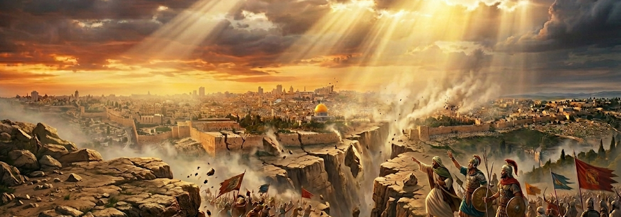
One of the main reasons some of our people reject Yeshua as the Messiah is because the Scriptures prophesy of a conquering King who will defeat Israel’s enemies and usher in a kingdom of peace. We look at the world today, and we do not see peace or victory. Instead, we see suffering, wars, and the ever-increasing state of antisemitism and anti-Zionism.
We wholeheartedly affirm these future prophecies of the victorious Messiah who will defeat our enemies and usher in an age of peace for both Israel and the world. At Yeshua’s first coming, he atoned for sin, as foretold in the Jewish Scriptures.1 At his return, he will defeat Israel’s enemies, reign from David’s throne in Jerusalem, and usher in a kingdom of peace, where “the wolf shall dwell with the lamb,” according to the Scriptures (Isa 11:6).
The War to End All Wars
When Yeshua returns, the Scriptures say he will wage war against the nations that are surrounding Israel attempting to destroy our Jewish people. He will fight in defense of Israel. The prophet Zechariah wrote:
Thus declares the Lord, who stretched out the heavens and founded the earth and formed the spirit of man within him: “Behold, I am about to make Jerusalem a cup of staggering to all the surrounding peoples. The siege of Jerusalem will also be against Judah. On that day I will make Jerusalem a heavy stone for all the peoples. All who lift it will surely hurt themselves. And all the nations of the earth will gather against it. . . . And on that day I will seek to destroy all the nations that come against Jerusalem. And I will pour out on the house of David and the inhabitants of Jerusalem a spirit of grace and pleas for mercy, so that, when they look on me, on him whom they have pierced, they shall mourn for him, as one mourns for an only child, and weep bitterly over him, as one weeps over a firstborn” (Zech 12:1–3, 9–10).
In this passage, God brings the surrounding nations against Israel for judgment. He then defeats Israel’s enemies once and for all, through the Messiah, the one “pierced” at His first coming. God pours out His Spirit on the people of Israel to see Yeshua as their Messiah.
Here, as one commentator explained,2
The prophet Zechariah envisions a future day when Jerusalem is besieged by its enemies and delivered by the Lord, who achieves victory on the battlefield and in the spiritual lives of His covenant people. By a special work of His Spirit, the Lord stimulates an attitude of penitence within His people over the one whom they rejected. The entire land, especially David’s ruling house, grieves over the act as one grieves the death of an only child.
A Pierced Messiah?
This Messianic interpretation of Zechariah 12 is not new. Some of the most prominent rabbis in Jewish history, such as Rashi, Ibn Ezra, Abarvanel, and Alshech, interpreted this passage as speaking of a slain Messiah, although they did not believe it spoke of Yeshua.3
The Talmud, in b. Sukkah 55a, says that in this last battle, Messiah ben Joseph will be pierced and killed, and then Messiah ben David will ask God to resurrect him from the dead, a request which God will grant. We believe the best interpretation is to understand Zechariah 12 and others like it as speaking of one Messiah and two comings. Yeshua came to suffer and die for our sins, was pierced on the cross, rose from the dead, and will return to destroy evil and Israel’s enemies once and for all!
The Lord Fights for You
In chapter 14, Zechariah describes the scene again:
For I will gather all the nations against Jerusalem to battle. . . . Then the Lord will go out and fight against those nations as when he fights on a day of battle. On that day his feet shall stand on the Mount of Olives that lies before Jerusalem on the east, and the Mount of Olives shall be split in two from east to west by a very wide valley. . . . And the LORD will be king over all the earth. On that day the LORD will be one and his name one (Zech 14:2–4, 9).
Note that it is the Lord himself who fights for Israel in this last battle, the Lord whose feet stands on the Mount of Olives, splitting it in two, and the Lord who will be King over all the earth. These truths are also said of the Messiah, who is prophesied to be both King over Israel and Lord. Yeshua, the divine Messiah, fits this prophetic picture perfectly.
Likewise, the New Testament says Yeshua will return to the Mount of Olives and restore the Kingdom to Israel (Acts 1:6–11) and that at his return, he will come with the armies of heaven and wage war against the nations (Rev 19:11–16).
Yeshua our Messiah came humble and lowly, riding on a donkey into Jerusalem, as the Jewish Scriptures foretold (Zech 9:9), and he will return on the clouds of heaven to wage war against God’s enemies and set up his eternal Kingdom of peace, according to the Scriptures. “And to him [will] be given dominion and glory and a kingdom, that all peoples, nations, and languages should serve him; his dominion is an everlasting dominion, which shall not pass away, and his kingdom one that shall not be destroyed” (Dan 7:13–14).
Footnotes
- To read more, check out the following articles: “Why Do We Need a Messiah?” at aboutmessiah.com/why-do-we-need-a-messiah and “Ten Reasons Why Isaiah 53 Points to Jesus” at aboutmessiah.com/ten-reasonswhy-isaiah-53-points-to-jesus.
- Daniel E. Stuart, “Zechariah 12:10–13:1: The Pierced Messiah,” in The Moody Handbook of Messianic Prophecy: Studies and Expositions of theMessiah in the Old Testament, ed. Michael Rydelnik and Edwin Blum (Chicago, IL: Moody Publishers, 2019), 1286.
- The Babylonian Talmud, trans. Isidore Epstein, vol. 14, Sukkah 52a (London: Soncino Press, 1938); Rashi, Commentary on Zechariah 12:10, in Mikraot Gedolot, accessed April 21, 2026, Sefaria; Abraham ibn Ezra, Commentary on Zechariah 12:10, accessed April 21, 2026, Sefaria; Don Isaac Abarbanel, Yeshuot Meshicho (Ferrara, 1497), discussion of Messiah ben Joseph and Messiah ben David; Moses Alshech, Commentary on Zechariah 12:10, in Marot HaTzovot, accessed April 21, 2026, Sefaria.



 Wikimedia Commons